
More Than Prompting
Originally published on jieyideng.substack.com.
What is SKILL.md?
In late 2025, Anthropic introduced the concept of SKILL.md: a standardized
set of instructions that teaches an Agent how to handle specific tasks or
workflows.
Think of SKILL.md not just as a prompt, but as a tool to preserve context for
repeatable workflows. Whether you are generating frontend designs from specs,
conducting research with a consistent methodology, or orchestrating multi-step
processes, SKILL.md acts as the bridge between raw intelligence and reliable
execution.
(Note: While you can apply any LLM to your SKILL.md, choosing models that have specific tuning or optimization towards SKILL use is recommended.)
How to Define Your SKILL.md
SKILL.md is fundamentally different from README.md. While a README explains
software to humans, a SKILL file explains a workflow to an AI. Before
structuring your file, you need to clarify four pillars:
- User Case: What is the exact goal the user wants to accomplish?
- Workflow Steps: What is the critical path? What multi-step sequence is required to finish the job?
- Tools & Data: What specific datasets or external tools are necessary context?
- Domain Knowledge: What industry best practices or “tribal knowledge” must be embedded to ensure quality?
Before writing SKILL.md, the most important step is not formatting but
problem framing. You need to clarify what users are trying to accomplish, what
sequence of steps is required, what tools and data are needed, and what domain
knowledge should be embedded as non-negotiable guidance. This is where many
teams fail. A weak SKILL.md behaves like static documentation. It sounds
comprehensive, but it does not reliably improve decision quality. A strong
SKILL.md behaves like an operational protocol. It defines when to activate,
what to verify first, what is not allowed, and how conclusions must be
structured before they are considered usable.
Once you grasp these basics, you can move from writing prompts to designing skills. Let’s look at a concrete example in Ad Analytics.
Example: The Ads Analytics SKILL.md
In Ads Analytics, teams are constantly under pressure to explain performance shifts, allocate budgets, and avoid expensive errors. The challenge isn’t whether a model can generate fluent text; the challenge is whether that text is grounded in the right objective, correct metric logic, and a valid sequence of reasoning.
In practical scenarios, logic beats fluency. A common mistake in performance analysis is metric misuse across incompatible objectives. For example, comparing an “Install-focused” campaign directly with a “Purchase-focused” campaign is a fundamental error. If objective alignment isn’t enforced early, the downstream analysis might look elegant, but it will be wrong.
Process Control over Prompt Engineering
A strong skill design prevents this by making “Objective Classification” a prerequisite, not an afterthought. It enforces a discipline most teams underestimate: Data Quality Checks before interpretation.
Many bad business decisions stem from small technical mismatches, for instance, missing fields, formatting inconsistencies, or data type errors. The fix isn’t a better prompt; the fix is process control. A good skill architecture inserts validation gates before the model attempts to generate insights.
Only after passing these gates does the model reach the interpretation phase. Here, structure beats improvisation. Instead of generic advice like optimize creatives, a skill-governed output follows a diagnostic chain:
- Cost efficiency worsened? Isolate the cause: Is it media cost? Engagement quality? Or post-click conversion dynamics?
This chain turns the output from a narrative artifact into an execution artifact.
Laid out end to end, the division of labour becomes the whole design. The runtime does the deterministic work — validating the query before a single provider call, compiling a typed execution plan, reconciling totals, emitting diagnostic signals — and only then hands a validated evidence package to the agent for synthesis.
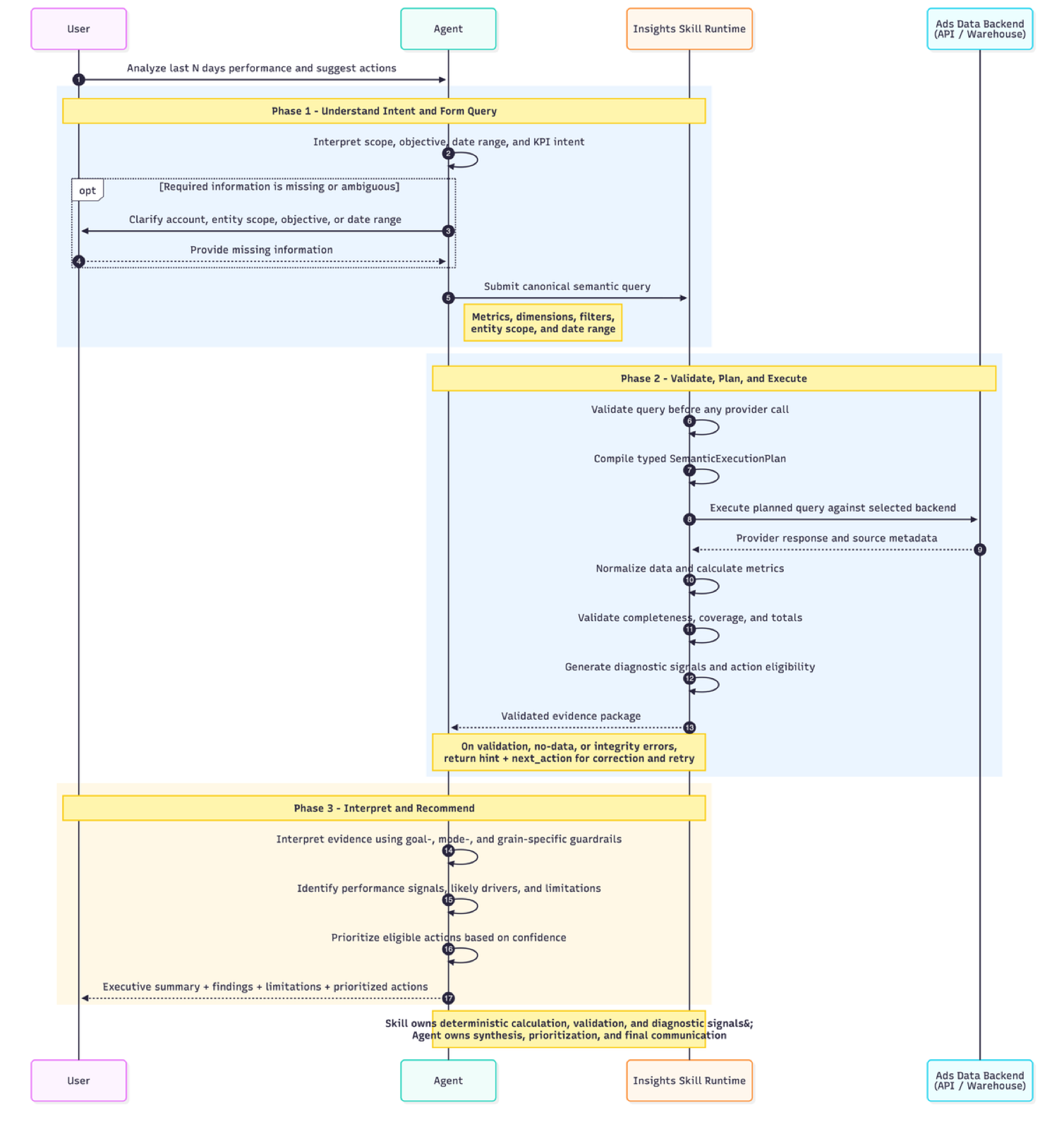
That boundary is what the folder structure has to encode. Here is the shape I use for analytics-heavy skills:
ads-insights-skill/
│
├── SKILL.md                        # Required — when to activate, the phase contract, hard limits
│
├── workflow/                       # One file per phase above
│   ├── phase1-form-query.md        # Interpret scope, objective, date range and KPI intent;
│   │                               #   clarify with the user when anything is missing
│   ├── phase2-validate-execute.md  # Validate → plan → execute → normalise → verify
│   └── phase3-interpret.md         # Guardrailed interpretation and action prioritisation
│
├── contracts/                      # The typed handoffs between agent and skill
│   ├── semantic-query.md           # Metrics, dimensions, filters, entity scope, date range
│   ├── execution-plan.md           # The SemanticExecutionPlan the runtime compiles
│   └── evidence-package.md         # What comes back, including hint + next_action on failure
│
├── rules/                          # Hard boundaries and error prevention
│   ├── query-validation.md         # Reject invalid queries before any provider call
│   ├── integrity-checks.md         # Completeness, coverage, totals reconciliation
│   └── guardrails.md               # Goal-, mode- and grain-specific interpretation limits
│
├── references/                     # Domain documentation
│   ├── metrics-definition.md       # KPI formulas and interpretation standards
│   └── schema-guide.md             # Data fields and structure reference
│
├── templates/                      # Standardized reporting outputs
│   └── report-template.md          # Executive summary → findings → limitations → actions
│
└── scripts/                        # Deterministic helpers — the skill calculates, it does not narrate
    ├── validate_query.py           # Type checks and missing-field validation
    ├── execute_plan.py             # Run the compiled plan against the selected backend
    ├── normalize_metrics.py        # Normalise provider responses into comparable metrics
    └── diagnostic_signals.py       # Emit signals and action eligibility for the agent
Pitfalls: Soft vs. Hard Constraints
While the initial version of SKILL.md performed well, extensive multi-round
testing has revealed some limitations. Specifically, in complex cross-campaign
comparisons, the model still occasionally commits the specific mistakes
outlined in our Error Prevention guidelines.
This occurs because SKILL.md functions essentially as a soft constraint for
the Agent. Instructions describe what should happen; they cannot guarantee it.
The issue is particularly pronounced when the underlying foundation model is
not Claude.
That is why the validator in the diagram above sits outside the model rather
than inside the prompt. The runtime rejects an invalid query before any
provider call, reconciles completeness, coverage and totals once the data comes
back, and on a validation, no-data or integrity error returns a hint and a
next_action so the agent corrects and retries instead of narrating around the
gap. A soft constraint asks the model to be careful. A hard constraint makes
the careless path unavailable. This level of rigor is critical for
commercialization; when dealing with financial data, we cannot afford any
margin for error.
Summary
Advertising analytics is the example, but the principle is broader: reliable agentic analytics requires deterministic calculation and validation before model interpretation. The more capable the model becomes, the more important it is to define what the system must verify before it is allowed to conclude.
That shift moves AI from response generation to workflow execution. Done well, it shortens time to insight, reduces analytical rework and makes decision quality more consistent without giving up the problem framing and judgment that data science still requires.